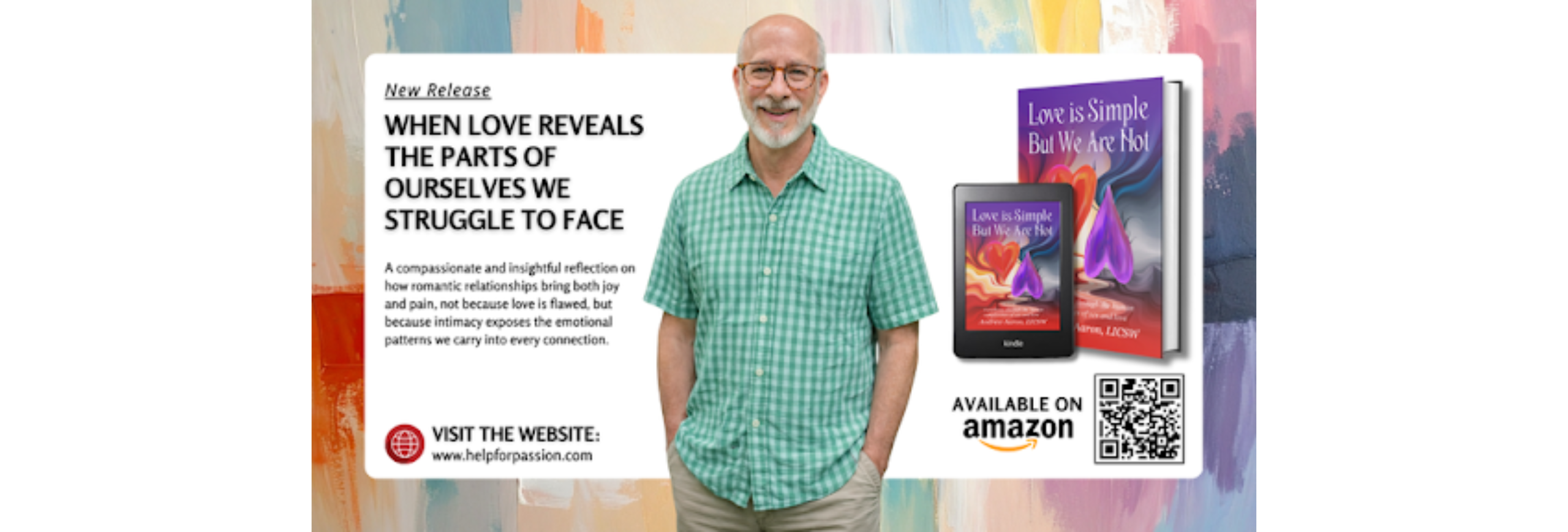

Have you ever wondered why loving someone feels like the most alive experience of your life and, at the same time, the most painful? Honestly, love, be it sexual or romantic in nature, has its own set of challenges. While many of us have a good loving connection, many can also feel dissatisfied during intimacy. Whether discussed out loud or in private, this topic usually doesn’t attend to the most neglected problem: emotional factors.
At the beginning of a romantic connection, joy and excitement often come easily as desire feels natural and closeness feels effortless. Over time, however, complications enter, misunderstandings develop, and intimacy becomes awkward. Many people assume this means something is broken. Andrew Aaron, LICSW, offers a different perspective. With more than 30 years of clinical experience as a sex therapist and marriage counselor, he brings to attention that love itself has not changed. But what has surfaced are the emotional limits each person brings into the relationship.
Love is Simple, but We Are Not: The Pathway Through the Human Complexities of Sex and Love by Andrew Aaron is here to put this topic into consideration. Drawing from over a three decades of excellence as a sex therapist and marriage counselor, Aaron explores how our sexual and romantic relationships expose our inner world and affect our emotional connection with our partner. The book asserts that loving another person requires vulnerability, patience, and emotional awareness. But when these qualities are underdeveloped, even deep affection can lead to heartache and displeasure.
One of the most valuable aspects of this book is its honesty about struggle. For example, Aaron discusses a wide range of sexual and marital challenges without turning them into labels or diagnoses. Instead, he focuses on how emotional habits shape behavior. This includes how fear of rejection may manifest as withdrawal, and fear of dependence that may manifest as control. Such sexual challenges often stem from emotional discomfort rather than physical issues, which the book links to the need for emotional growth, helping men and their partners grasp what is truly occurring beneath the surface.
Moreover, the short chapter format, developed from a fifteen-year magazine column, makes the book approachable and reflective. Every section of this book stands on its own while contributing to a broader understanding of how people love, inviting readers to pause, reflect, recognize themselves, and consider new ways to address relationship and love issues. The suggestions offered are invitations to explore awareness, communication, and responsibility.
Aaron also emphasizes that love deepens as individuals grow emotionally, and that this growth does not come from changing a partner. It comes from understanding one’s own limits and gently expanding them. By discussing real-life examples and practical insights, the book also encourages personal questions that open meaningful conversations between partners. What am I afraid of here? What do I avoid? What do I need but struggle to ask for? These questions create space for connection that feels more honest and grounded.
Love is Simple, but We Are Not is especially valuable for readers who feel stuck in repeating negative patterns. By highlighting various challenges and countless variations that lovers and romantic partners face when attempting to love, this book offers reassurance that complexity in love and intimacy does not mean hopelessness. Instead, with proper guidance and emotional regulation, anyone facing struggles in love can strengthen their capacity to give and receive love, while also acknowledging the importance of a romantic partner. By understanding how limitations form and how they show up in intimacy, this book can help readers gain the tools to move toward a more emotionally and physically connected relationship.
For men and their female partners who painfully realize how anxiety can interfere with a successful sexual connection, Andrew Aaron explores that specific experience further in his second book, When Soft is Hard: Escaping the Cycle of Sexual Performance Anxiety, which focuses on breaking fear-driven patterns that undermine satisfying intimacy.
Availability:
The book is available on Amazon for purchase: https://www.amazon.com/dp/B0D9DP78TX. About the Author:
Andrew Aaron, LICSW, graduated with a Masters degree in Social Work from Simmons College, Graduate School of Social Work in 1994. For more than 30 years he has helped hundreds of couples and individuals get beyond problems, feel better and love more fully. During his internships in 1992 and 1993, he began working with individuals and couples. Shortly after graduating, he took jobs in both Fall River and New Bedford Massachusetts working with a wide variety of people including the elderly, couples, adults and children.
For four years starting in 1997, he worked in a locked facility for teenage boys helping misdirected, often violent, male teens straighten out their lives’ paths. For two years, starting in 1999, Andrew received additional education and training in the sphere of human sexuality and love relationships. Also in 1999 he started his private practice in New Bedford, within the professional group mental health practice of Psychiatric and Psychological Associates. Currently, he actively helps couples and individuals in his private practice.
He has presented publicly, hosted a radio program, written several books, been on television, regularly been the focus of a podcast, written a column for the Standard Times Newspaper, been a contributor to articles in Cosmopolitan Magazine as well as numerous online media outlets and for fifteen years was a monthly columnist for SoCo magazine on the topics of sexuality, intimacy, passion and love relationships.
Book Details:
Book Name: Love is Simple, but We Are Not: The Pathway Through the Human Complexities of Sex and Love
Author Name: Andrew Aaron LICSW
ISBN Number: 979-8329333817
Ebook Version: Click Here Paperback Version: Click Here
Written in partnership with Tom White