
The condition of being oneself and not another, including your qualities and beliefs, and a sense of self that motivates and energizes you to act and live intentionally, are some of the meanings you would discover if you looked up the word “identity.” But identity is the very essence of who you are. It shapes how you think, respond, decide, and move through life. It gives confidence to carry out daily responsibilities and to pursue goals with clarity, as well as influences choices quietly and consistently, often without conscious awareness.
We draw our sense of self from many sources, including family background, cultural associations, socioeconomic circumstances, personality traits, beliefs, and lived experiences. Even when certain aspects and things are not personally preferred, we often try to accommodate them in our lives, as they reinforce unity and shared identity and help us to grow.
However, not everyone grows up with stable or affirming foundations. Some individuals come from fractured homes or inconsistent environments. Therefore, understanding our identity is essential for living a stable and balanced life, gaining clear insight, and navigating life with increased clarity and resilience.
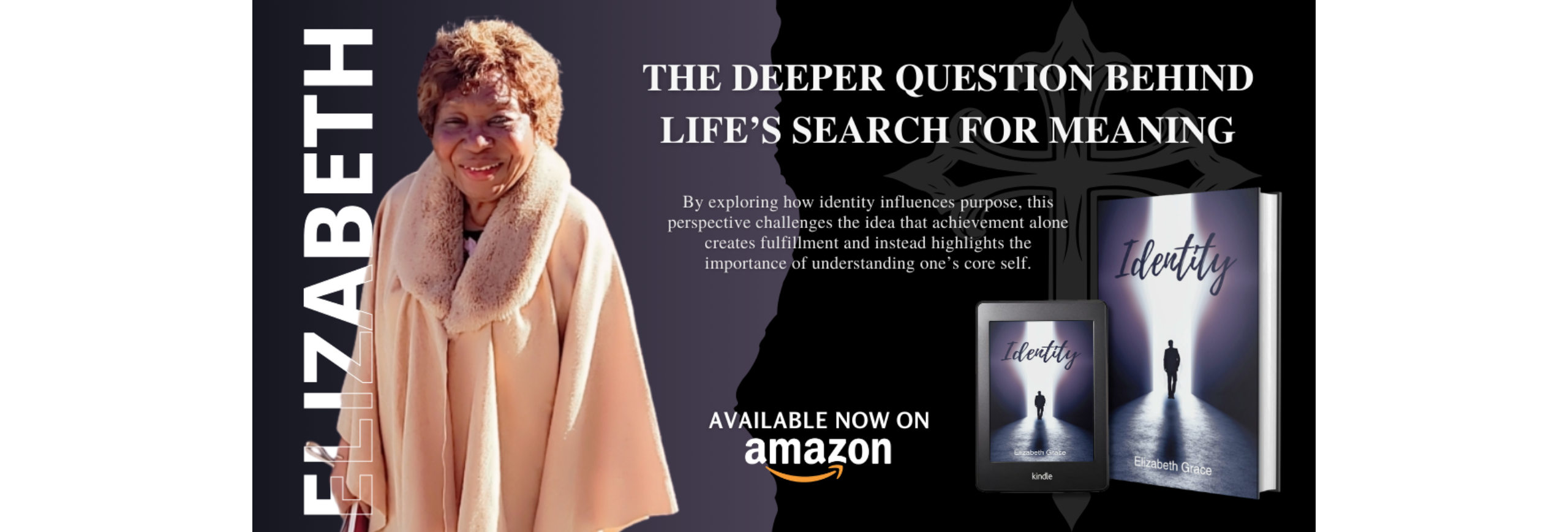
In Identity, Elizabeth Grace carefully unpacks this reality. She explains that much of the confusion people experience today is not simply about circumstance. It is about disconnection from a stable understanding of who they are. When identity becomes unclear, everything else begins to shift.
Identity rarely collapses overnight. It drifts. It changes gradually as people begin to define themselves by external markers. A promotion becomes proof of worth. A relationship becomes a validation of value. Social approval becomes a measurement of significance.
At first, these things seem harmless. They even feel motivating. But when identity depends on them, stability becomes fragile. When success fades or relationships end, people often feel as though they have lost themselves.
Grace highlights this pattern by examining common life transitions. Retirement, divorce, career changes, or even children leaving home can create a deep sense of disorientation. The struggle is not simply about change. It is about realizing that identity was tied too tightly to a temporary role.
The strength of Identity lies in its return to Scripture. Grace does not offer motivational slogans. She returns to Genesis and reminds readers that identity began with creation. Humanity was made in the image of God. That identity came before any responsibility or achievement.
Adam’s confusion began only after fellowship with God was broken. Grace explains that this separation introduced instability. When connection to the Creator was lost, identity became vulnerable. Humanity began searching outward for what had originally been secured inward.
This framework provides clarity. If identity originated in a relationship with God, then restoration must also begin there.
Grace supports her argument by examining the lives of biblical figures who experienced identity crises of their own.
Jacob struggled with insecurity and deception before coming to understand his place in God’s plan. David faced rejection from his own family, yet found confidence not in public approval but in his relationship with God. Peter faltered and denied Christ, temporarily losing clarity about his purpose, yet he was restored and became a leader in the early church.
These stories are not presented as idealized accounts. They are real examples of human weakness. What unites them is not perfection, but transformation through renewed identity.
When identity is restored, direction follows. Grace emphasizes that purpose becomes clearer when individuals understand their foundational relationship with God. Decisions become less reactive. Fear loses its control. Confidence grows quietly but steadily.
This does not mean life becomes simple. It means life gains coherence. There is a thread connecting choices, responsibilities, and challenges.
A person who knows who they are does not need constant validation. They are less shaken by criticism. They are less inflated by praise. Their direction is not dictated by trends.
Modern society encourages self-definition without spiritual grounding. People are told to construct identity according to preference or feeling. Grace respectfully challenges this approach, suggesting that identity without a stable foundation leads to fragmentation.
In a culture filled with noise, Identity offers steadiness. It reminds readers that direction is not found in constant reinvention. It is found in returning to the source of identity itself.
When identity is secure, life may still include hardship. But it will not include confusion about who you are. And that clarity changes everything. For those seeking clarity, Identity by Elizabeth Grace reminds readers that true identity is not given by the world but rooted in faith and spiritual understanding.
Availability:
The book is available on Amazon: https://www.amazon.com/dp/B0FHMG7Q11/. About the Author:
Elizabeth Wariboko has been a committed Christian for 42 years. As a Christian, she engaged her talents in the church community and served as a Sunday School teacher, preacher, and teacher of the Word of God, serving on various committees from time to time in the furtherance of God’s work and the building up of the church of God.
She worked successfully as an educator for 44 years as a high school teacher. Her practice as an educator was centered on the philosophy that each student brought their unique personalities and backgrounds to the classroom. She therefore focused her practice on catering to the individual differences of her students.
Life and experiences have shown her that she is a lifelong learner, greatly interested in the behavior of her students and people in general, finding out what motivates them to think and behave the way they do.
Her strong commitment to the word of God and some understanding of human behavior as exposed by her experiences has enabled her to gain insights on issues in general, and raising five children of her own and the learning process of that exercise has helped to fashion her views on life.
Elizabeth is retired and lives in Minnesota.
Book Details:
Book Name: Identity
Author Name: Elizabeth Grace
ISBN Number: 979-8895265079
Ebook Version: Click Here
Hardcover Version: Click Here Paperback Version: Click Here
Written in partnership with Tom White