
Image credit: Pexels
From automated interview scheduling to psychometric coaching engines, a new wave of AI HR tools is revamping talent identification, assessment, and retention for companies.
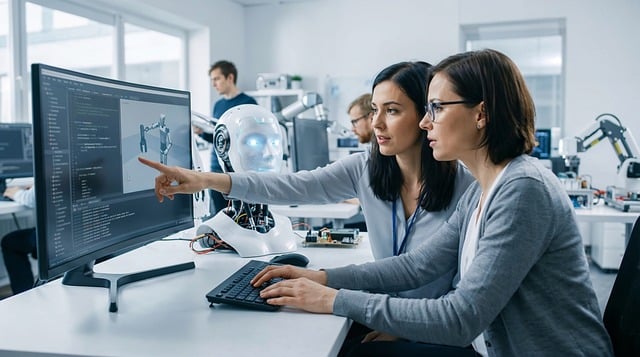
The way companies find, screen, and hire talent is undergoing a major shift. Artificial intelligence is gradually replacing manual workflows that once delayed recruitment and introduced bias. Across industries, AI-driven hiring platforms are moving beyond automation to establish a practical infrastructure layer for modern recruiting.
The companies at the forefront of this change are approaching the problem from different angles. Some focus on speeding up communication, while others prioritize candidate quality, data privacy, or leadership development. Together, they illustrate how AI is rewriting the rules of recruitment and workforce management.
Speeding Up the Hiring Funnel
For many employers, one of the biggest recruiting bottlenecks is scheduling interviews. Coordinating calendars through emails and phone calls often stretches hiring timelines unnecessarily, particularly for high-volume roles.
GoHire, Inc. is targeting this friction point with a text-based AI system that automates interview scheduling from start to finish. The platform analyzes recruiter availability, sends scheduling options to candidates through SMS, and books interviews once a candidate replies.
According to founder and CEO Jonathan Duarte, the automation dramatically reduces delays that traditionally slowed hiring teams.
“One of our clients, Deloitte University, used to have eight people in their recruiting team. They went down to two, but hired 400 people in three months — because 92% of candidates would self-select and schedule themselves within 24 hours,” he said.
Duarte believes that the challenge is often less about software adoption and more about organizational habits. “Process change is 10 times harder than software change.”
The company’s pre-screening automation also filters candidates using eligibility questions before recruiters step in, reducing manual review time and accelerating decision-making.
“It used to take seven to 14 days, even to hire hourly people. We can now do that in 24 to 48 hours — which is better for the candidate because they have a new offer right away,” Duarte stated.
AI Moves Executive Recruiting Toward Strategy
While automation has improved speed, executive search firms are increasingly using AI to deepen candidate analysis and reduce repetitive administrative work.
Managing partner at PRL International, Philip Lamb, said AI has fundamentally changed recruiter productivity. Instead of spending hours on cold outreach and resume reviews, recruiters can focus more heavily on strategy and client advisory work.
“Each person on each desk, it quantifies into a desk of 10. So it’s equivalent to 10 people doing the work,” he explained.
A major focus for PRL International is what Lamb describes as sovereign AI, which is private, company-controlled language models designed to keep recruiting data secure from public systems.
“Imagine a corporation with a massive amount of data they want to protect. If you ring-fence it with a sovereign AI system, you now have the ability to search through all of the data and find out exactly what you need — and it’s all yours.”
The operational gains, Lamb noted, have also changed the recruiter’s role.
“Because of the time being freed up, I’m able to meet with clients and talk to them about what they really want and strategize. Pre-AI, I was just dealing with resume after resume. Now I have higher quality candidates and I can be more strategic for my clients,” he said.
Process Over Volume
Hireology was built on the idea that many organizations approached hiring as a numbers game rather than a structured process. The platform now supports more than 10,000 businesses across industries, including automotive, hospitality, and healthcare.
Its AI-powered job description writer shortens the lengthy administrative task into a faster, more standardized workflow.
According to Lauren Polito, PR Professional at Hireology, “What normally took hiring managers probably an hour now takes them less than 10 minutes. And especially for multi-location operators, that consistency is where Hireology really comes in.”
The company is also testing AI Interview and AI Match tools aimed at reducing hiring bias while helping employers identify strong candidates earlier.
“Our team put a lot of time into the legal aspects of AI Interview to ensure that it reduces bias, and that there are many checkpoints along the way to ensure that humans are still at the heart of decisions,” she stated.
MaryKate Larsen, Communications Manager at Hireology, explained, “Companies were really just wanting to get applicants through the door. But what Adam saw is that no one truly had a good process in place — no one was holding on to the importance of all of these steps in between.”
Personalizing Leadership Through AI
Beyond recruitment itself, AI is also expanding into coaching and workforce management.
Humantelligence combines AI with psychometric assessments to personalize leadership guidance through its Ask Aura coaching platform. Instead of delivering standardized responses, the system tailors advice to an employee’s behavioral profile, values, and communication style.
CEO John Betancourt said that distinction separates the platform from a growing field of generic AI coaching tools.
“There are now 50 or more AI coaching products. None of them have a personalization engine that’s driven by psychometrics. If 10 leaders ask how to manage their team, they get 10 completely different answers — because every team is different.”
The platform has already scaled inside major enterprises.
“We have about 80,000 people on the platform at Coca-Cola. We get about 20 uses per person per month. And 92% of managers say this tool helps them manage their team better,” Betancourt said.
Betancourt believes AI-driven workplace coaching will soon become standard infrastructure across organizations.
“Everyone in the world will use a tool like this in the next four years — whether it’s mine or not, I can’t say. But there will be a tool like this everywhere, for every company, for every employee.”
The Future of Talent Hiring
From interview scheduling to leadership development, the latest generation of AI HR tools is removing the manual friction that slows human decision-making. Rather than replacing recruiters and managers, these platforms are designed to improve the way people evaluate talent, communicate with candidates, and build stronger teams.