
Most people imagine financial crises as chaotic, visible events—markets crashing, headlines flashing, governments scrambling in public view. But what if the real story unfolds somewhere else entirely? What if the most important decisions are made quietly, behind closed doors, long before the public ever realizes something is wrong?
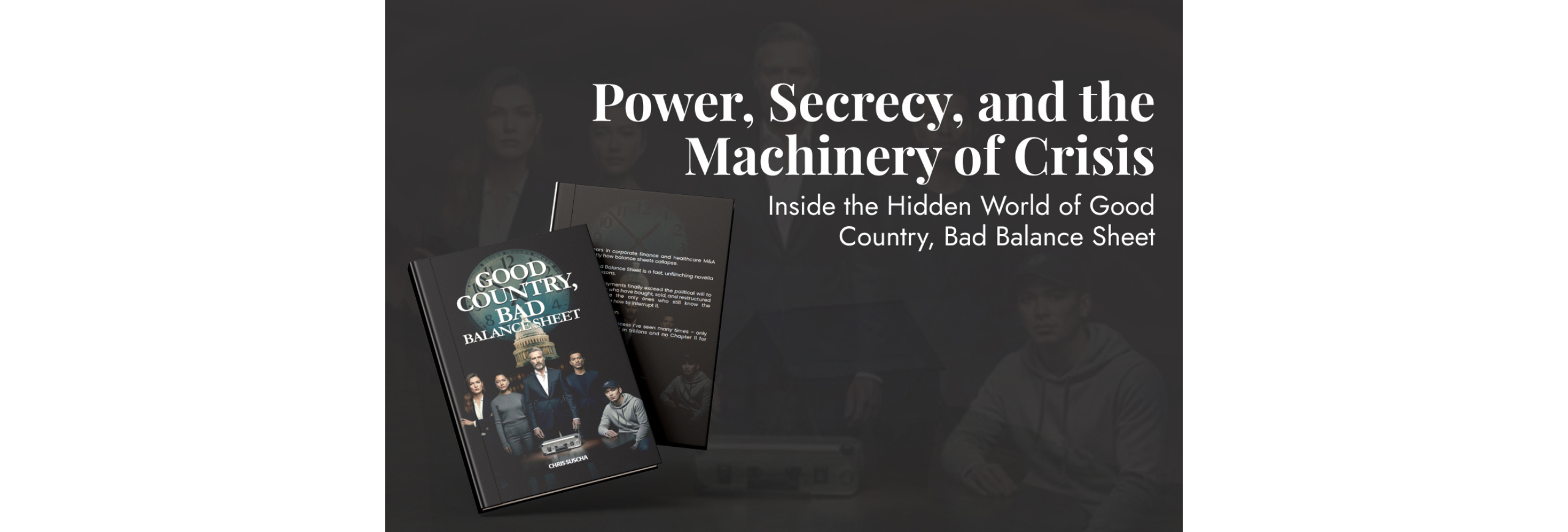
Good Country, Bad Balance Sheet invites readers into that hidden world. It is not just a story about debt or economic instability; it is a story about power—who holds it, how it is used, and what it costs to maintain control when the system itself is under threat.
At its core, the novel explores a rarely discussed reality: that modern financial stability is not purely the result of markets functioning naturally. It is often the outcome of deliberate, coordinated actions taken by a small group of actors operating with both urgency and discretion.
The Invisible Architecture of Power
Power in financial systems is rarely obvious. It does not announce itself or operate through dramatic gestures. Instead, it exists within institutions—central banks, treasury departments, major financial firms—that influence outcomes through policy, capital flows, and strategic decisions.
The novel captures this dynamic with precision. The individuals at the center of the story are not traditional heroes or villains. They are operators—people who understand the system deeply enough to navigate it, but who are also constrained by its complexity.
This portrayal reflects a fundamental truth. In modern finance, power is not about absolute control. It is about influence. It is about the ability to shape conditions, guide outcomes, and maintain stability in environments that are inherently unpredictable.
Secrecy as a Strategic Tool
One of the most striking elements of Good Country, Bad Balance Sheet is its treatment of secrecy. In many narratives, secrecy is associated with deception or wrongdoing. Here, it is presented as something more nuanced—a tool that can be used to protect stability as much as to conceal information.
Financial systems are highly sensitive to perception. Information can move markets, alter behavior, and create self-reinforcing cycles of optimism or fear. In such an environment, full transparency is not always practical in real time.
The manuscript suggests that certain decisions must be made quietly to avoid triggering unintended consequences. This does not eliminate the need for accountability, but it does complicate how and when information is shared.
This tension between transparency and discretion is one of the defining features of the story. It raises important questions about how much the public should know—and when.
Crisis as a Test of Systems
Crises do not create systems; they reveal them. Under normal conditions, financial structures operate smoothly, supported by established rules and expectations. In times of stress, those structures are tested.
The novel uses its crisis scenario to expose the underlying mechanics of the system. It shows how decisions are made, how risks are managed, and how stability is maintained when conventional approaches are no longer sufficient.
This process is not clean or straightforward. It involves trade-offs, uncertainty, and constant adjustment. The characters must navigate competing priorities, balancing immediate needs against long-term consequences.
What emerges is a portrait of a system that is both resilient and fragile—capable of adapting under pressure, but vulnerable to the very forces it is designed to manage.
The Role of Coordination
No single institution can manage a systemic crisis alone. The scale and complexity of modern financial systems require coordination across multiple actors, each with their own mandates and constraints.
The novel emphasizes this need for alignment. Decisions are not made in isolation; they are part of a broader network of actions that must work together to achieve a desired outcome.
This coordination is one of the most challenging aspects of crisis management. It requires trust, communication, and a shared understanding of objectives. When these elements are present, the system can stabilize. When they are not, the risk of fragmentation increases.
The Ethical Dimensions of Power
Power, particularly in times of crisis, raises difficult ethical questions. Who decides what actions are justified? How are the costs and benefits distributed? What happens when the interests of the system conflict with those of individuals?
Good Country, Bad Balance Sheet does not offer easy answers. Instead, it presents these questions through the experiences of its characters. They must make decisions with incomplete information, knowing that their choices will have far-reaching consequences.
This uncertainty is central to the narrative. It highlights the human element of financial systems—the fact that behind every policy and every market movement are individuals making judgments under pressure.
Why the Story Resonates Today
The themes explored in the novel are not confined to fiction. They reflect real-world concerns about transparency, accountability, and the concentration of power within financial systems.
In recent years, there has been growing awareness of how interconnected global markets have become. Events in one region can have immediate effects elsewhere, creating a sense of vulnerability that is both economic and psychological.
The novel taps into this awareness, offering a narrative that feels both timely and relevant. It does not exaggerate reality; it distills it, focusing on the elements that matter most.
The Cost of Maintaining Stability
Stability is often taken for granted. When markets function smoothly and economies grow, it is easy to assume that the system is inherently stable. The novel challenges this assumption by revealing the effort required to maintain that stability.
Behind the scenes, there are constant adjustments—policies being refined, risks being monitored, strategies being developed. These efforts are rarely visible, but they are essential.
The story suggests that stability is not a natural state, but an achievement. It is the result of deliberate action, informed by experience and guided by judgment.
A Narrative That Reveals More Than It Conceals
While the novel deals with secrecy, it ultimately reveals more than it hides. It provides insight into how systems function, how decisions are made, and how crises are managed.
This transparency is not literal, but conceptual. Readers come away with a deeper understanding of the forces at play, even if the specifics remain fictionalized.
This balance between concealment and revelation is one of the strengths of this book. It engages readers while encouraging them to think critically about what they are reading.
Conclusion: The System Behind the Story
Good Country, Bad Balance Sheet is not just a story about a financial crisis. It is a story about the machinery that operates beneath the surface—the networks of power, the necessity of secrecy, and the constant effort required to maintain stability.
By bringing these elements into focus, the novel offers something rare: a glimpse into the hidden workings of modern finance. It reminds us that what we see on the surface is only part of the story.
The real narrative unfolds in the spaces we do not see—in the decisions that are made quietly, the risks that are managed carefully, and the systems that continue to function because of efforts that rarely make headlines.
And in revealing that hidden world, the book does more than tell a story. It changes how we understand the one we are already living.
Written in partnership with Tom White